

Several programmes are dedicated worldwide to the development of reusable vertical take-off vertical landing (VTVL) launch vehicles. Thereby, the touchdown event with its associated impact forces and shocks poses load cases to the vehicle being new in the launcher domain. Depending on flight test conditions and operational concept, non-neglectable amounts of liquid propellant can still be inside the tanks at landing and interact with the vehicle. These interactions cause dynamic and structural effects that affect the landing stability and structural integrity of the vehicle. This study aims to experimentally investigate the fluid-vehicle interactions of a fully functional touchdown demonstrator (TDD) during touchdown. For this, a lander engineering model is equipped with a circular cylindrical tank and a series of touchdown test with varying horizontal landing velocities and fill levels is conducted. Thereby, the main objectives are to prove repeatable landing behaviour under sloshing impact for constant landing conditions, to characterise the fluid impact on landing stability and investigate the fluid-structure interactions on the tank. Therefor test data of different test cases is compared and analysed with regards to dynamic behaviour and structural responses.
This study and experiments in the framework of the Horizon Europe project SALTO were performed at DLR – German Aerospace Center, Institute of Space Systems, Landing and Exploration Technologies, Bremen, Germany by Caroline Krämer and Lars Witte.
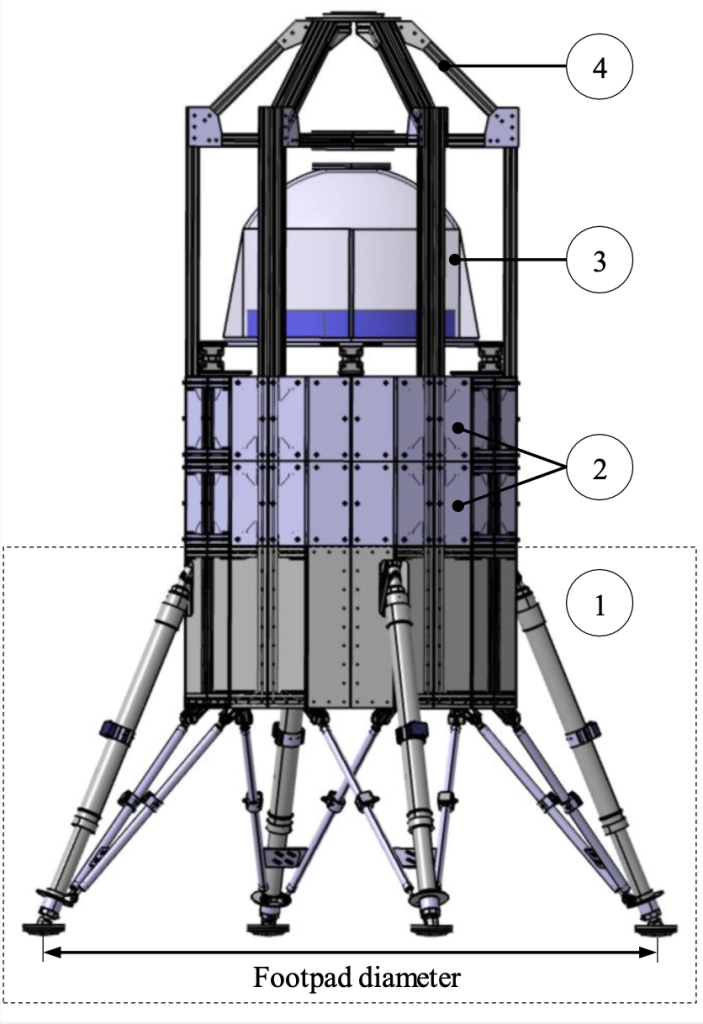
- Vehicle aftbay with four landing legs in ‘inverted tri-pod’ configuration
- Reinforcement Rings
- Tank
- Robot Adapter and Horizontal Reinforcement
Test Facility
The tests were performed in the Landing and Mobility Test Facility (LAMA) at the DLR-institute of space systems in Bremen, Germany. As the robot follows a pre-programmed path, the test sequence can be completely automated and constant drop conditions and a precision landing can be ensured. At the release point the test object will have the pre-defined horizontal velocity. The release height has to be chosen with respect to the test object’s size, so that the required vertical landing velocity is achieved by the free fall until ground contact. For this campaign the landing zone is equipped with concrete plates, placed on rubber mats to prevent sliding during touchdown. The concrete plates are chosen to ensure defined touchdown conditions in terms of stiffness and roughness.
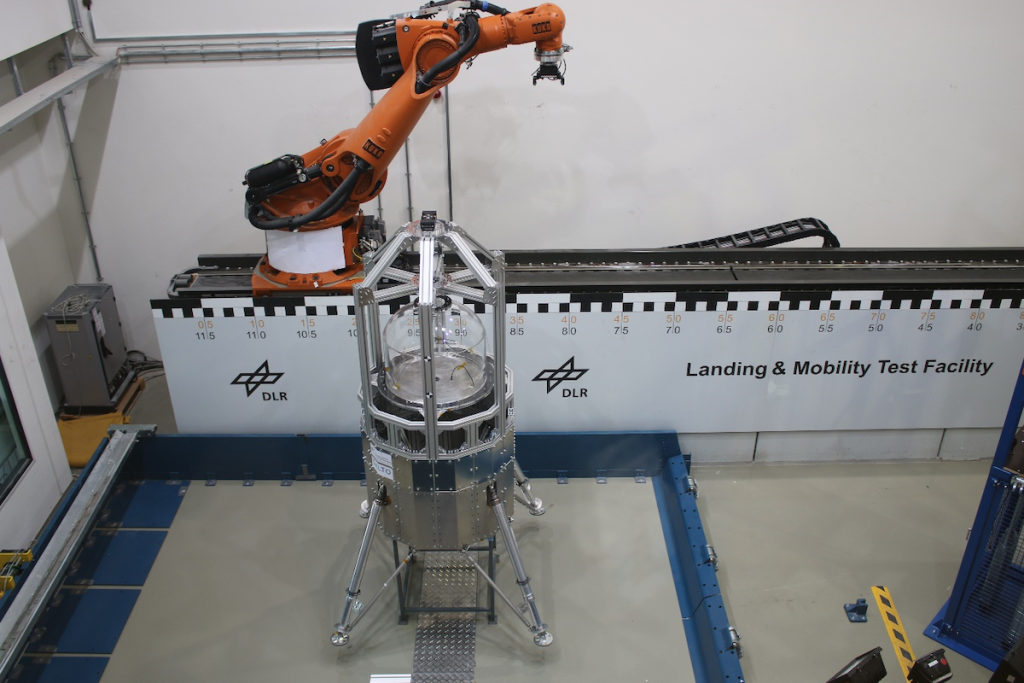
Landing sequence
and sloshing wave
A 6-axis robot picks up the TDD and accelerates it to the desired horizontal landing velocity. At a before defined position the TDD is released and touches down in the landing zone. After touchdown the TDD performs a tilting motion and the fluid begins to slosh inside the tank.
Landing tests with varying horizontal landing velocities and fill levels are conducted.