

As part of the SALTO project the future of spaceflight is being reimagined — through careful, calculated steps in Europe’s research labs and test facilities. Behind the thunder of rocket engines lies a quieter revolution: the methodical development of reusable launch technology that could reshape how Europe accesses space. This is not about chasing spectacle—it’s about mastering complexity, one carefully crafted demonstrator at a time, on the path from short hops to orbital return.
From Hop tests to orbit-capable vehicles
One of the key dimensions of the SALTO project is the maturation of technologies required for future reusable launchers. While the T1H demonstrator draws much attention for its vertical hop tests, the focus is already extending beyond this toward more advanced demonstrators and ultimately, full-scale orbital vehicles. The challenge lies in transforming a low-altitude test into the intricate sequence of an orbital launch, stage separation, atmospheric re-entry, and a controlled landing.
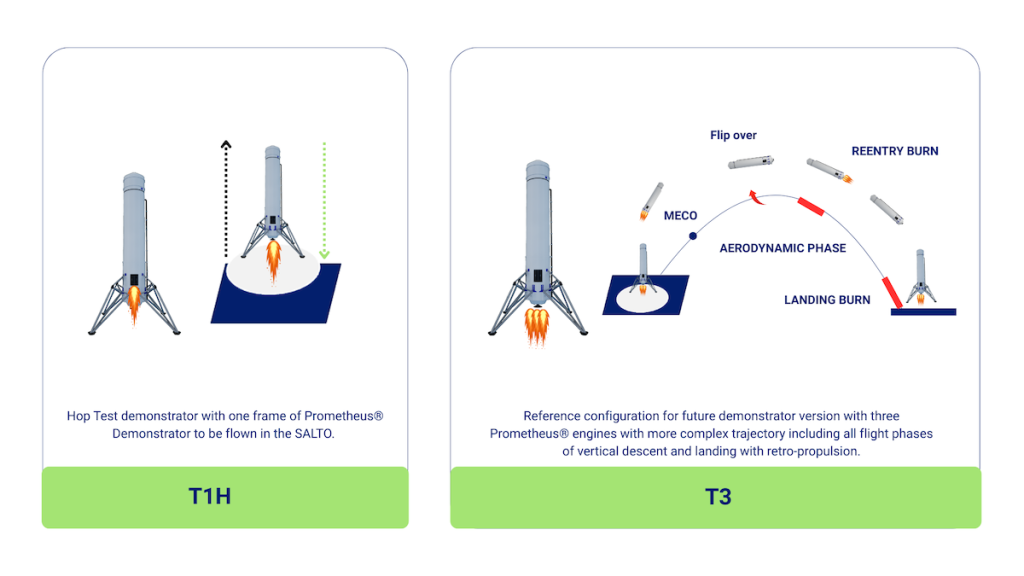
To bridge this technological gap, the T3 demonstrator has been introduced. It is specifically designed to build on the lessons from T1H while replicating the key dynamics of an operational reusable launcher. This structured progression is critical for reducing risk, validating complex flight systems, and bringing these technologies closer to operational readiness.
Three steps forward: T1H, T3 and future launchers
T1H, the current centerpiece of SALTO’s hardware efforts, represents a simple but critical proof of concept: a vertical takeoff, brief ascent, and vertical landing, powered by a single Prometheus® engine. In contrast, full-scale launch vehicles may have five or even nine engines and will have a second stage to deliver the payload to the final orbit. This comes with a more complex descent trajectory for the first stage. Between these lies T3—designed to include multiple engines and rehearse critical flight phases such as re-entry burns and aerodynamic deceleration.
This stepwise approach reflects a key principle of aerospace development: technological maturity must grow with mission complexity. While T1H enjoys a high Technology Readiness Level (TRL) due to imminent flight testing, T3 is still in detailed design, and future launcher configurations remain at a conceptual level, relying on early-stage modeling and estimations.

Why T3 is a vital bridge
The jump from T1H to full-scale launchers is not as straightforward as adding more engines. The physics—and the challenges—change dramatically. Full-scale launchers must manage high thermal and structural loads during hypersonic descent, maintain aerodynamic control throughout complex trajectories, and perform pinpoint landings after staging. These requirements introduce design and engineering challenges that T1H alone cannot address.
T3 serves as a testbed for these intermediate challenges. With three Prometheus® engines, it begins to scale thrust levels. It includes features like a jettisonable fairing, grid fins, and landing legs, bringing it closer in behavior and form to a real launch vehicle. Its trajectory mirrors that of an operational stage return, including burns for deceleration and re-entry, aerodynamic glide, and landing burn. These maneuvers demand precise flight dynamics control, advanced thermal protection, and structural resilience.
Engineering the transition: aerodynamics and thermal loads
One major area of focus at DLR is understanding the aerodynamic and aerothermal behavior of these vehicles. While T1H operates in a regime where thrust vectoring is dominant and aerodynamic forces are minimal, T3 and orbital stages must survive—and harness—complex airflows during descent.
To this end, DLR employs a combination of low-fidelity and high-fidelity Computational Fluid Dynamics (CFD) and experimental wind tunnel testing. These efforts produce aerodynamic databases used in simulations and control system development. One example: refining the grid fin design for improved efficiency without increasing mass, which required balancing aerodynamic performance with structural integrity.
Aerothermal simulations at DLR reveal how vehicle surfaces heat during re-entry, especially around the engine section immersed in its own exhaust plume. CFD models inform the design of the thermal protection system, developed in collaboration with partners such as Amorim-Cork Solutions, to withstand extreme temperatures using innovative materials like cork-based ablatives.
Testing, simulation and structural design
Wind tunnel testing remains a cornerstone of SALTO’s verification approach. DLR uses a trisonic wind tunnel (TMK) to validate CFD results, investigate flow behavior in conditions hard to simulate numerically, and assess unsteady pressure loads. These experiments feed directly into the vehicle’s structural and control system design.
The T3 demonstrator’s structures—such as landing legs and grid fins—are the result of extensive collaboration. MT Aerospace contributes to landing leg design, optimizing for load conditions during both ascent and descent. SABCA, responsible for grid fins, works with DLR to align aerodynamic and structural requirements, ensuring survivability and control effectiveness under dynamic conditions.
Thermal protection, too, is integrated into this collaborative design loop. Engineers simulate hot plume interactions and test material response in dedicated facilities, such as the hot plume testing facility (HPTF) and DLR’s L2K arc heated wind tunnel. These tests determine whether surfaces near the engine bay can withstand sustained thermal loads without degrading.
Simulating the flight: control, stability and landing precision
Beyond hardware, DEIMOS focuses heavily on flight dynamics and control. Using detailed aerodynamic models, teams simulate the entire flight sequence—from ascent to descent to landing—and assess controllability at every phase. This includes the development of flight control laws and stability analysis to ensure that vehicles respond predictably to control inputs and external forces.
These simulations are essential, especially when preparing for downrange landings on seagoing platforms. Advanced guidance, navigation, and control (GNC) systems must guide the vehicle through re-entry, aerodynamic maneuvering, and final approach—all while compensating for varying atmospheric conditions and vehicle dynamics.
Future launchers: conceptual work for scalable systems
The final piece of work by DLR, DEIMOS and MT Aerospace within SALTO involves conceptual studies of future launch vehicles. These designs are rooted in configurations from the ESA-NESTS study, incorporating five to nine Prometheus® engines and refined versions of the T3 aerodynamic shape. Though these vehicles remain at low TRL, the work is essential to validate whether technologies developed for T1H and T3 scale effectively.
Key goals include evaluating mass scaling, thermal protection needs, aerodynamic efficiency, and structural behavior in full-scale scenarios. While no wind tunnel testing is performed at this stage, CFD, mission analysis, and structural modeling provide foundational insight. The team also investigates whether components like grid fins or landing gear need fundamental redesigns—or if they can evolve from earlier demonstrators with only minor adaptation.
A roadmap to reusability
In summary, the work performed on technology maturation in SALTO is a methodical, research-driven progression from simple hop tests to complex orbital launchers. Each demonstrator—T1H, T3, and future configurations—serves a strategic role in maturing technologies at the right scale and readiness level.
By combining simulation, experimental testing, and close collaboration of European research institutes and industry partners, this ensures that reusable launcher technologies not only function, but thrive in the demanding conditions of orbital spaceflight and atmospheric return. The result: a roadmap for Europe’s entry into the reusable launcher era, grounded in science, validated by data, and driven by design.