

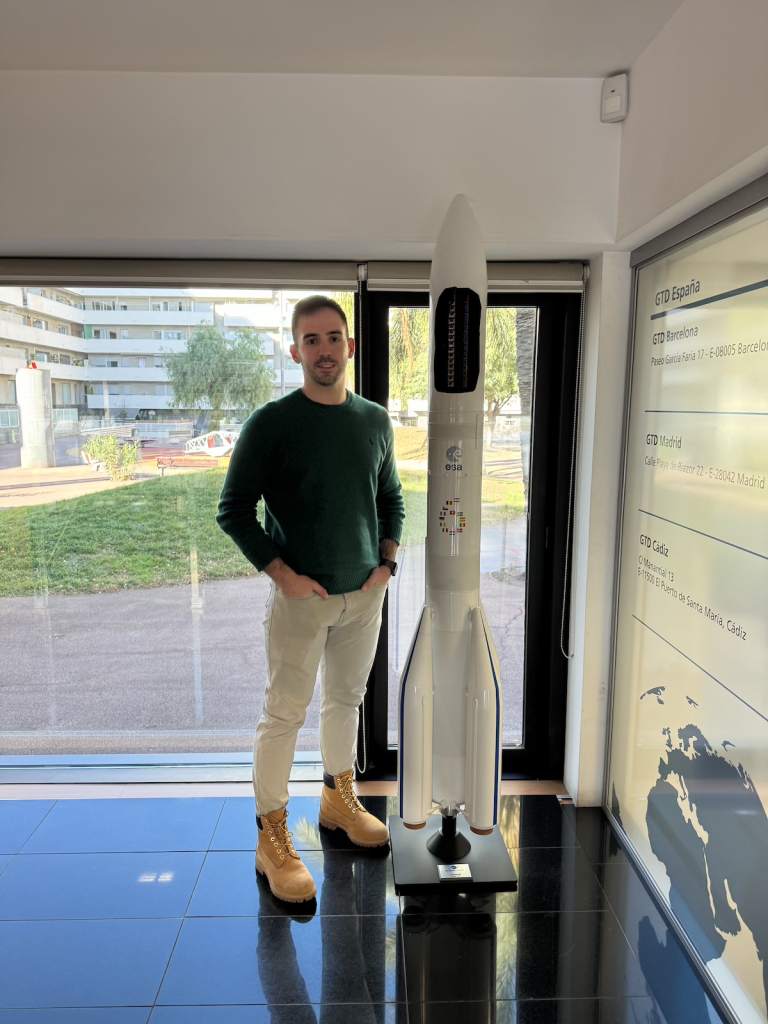
The SALTO Horizon Europe project congratulates Alejandro Saban, a member of the GTD team and SALTO consortium partner, on successfully obtaining his PhD at Universitat Politècnica de Catalunya, Spain. His doctoral research, titled “End-to-end design and development of an autonomous flight safety system enabling reusable space missions in Europe,” represents an important contribution towards safer and more efficient future reusable launch systems.
As Europe moves towards the development and operation of reusable space transportation technologies, new approaches to flight safety are becoming essential. Dr. Saban’s research addresses this challenge through the design, development, and validation of an Autonomous Flight Safety System (AFSS) specifically tailored for reusable launch vehicles and aligned with European regulatory and certification requirements.
The thesis presents a complete end-to-end approach for implementing autonomous range safety capabilities. Using a model-based systems engineering methodology, the research defines and structures an AFSS architecture integrating key functions such as navigation, flight dynamics assessment, decision-making, and vehicle health monitoring. Each module was developed and individually validated as part of a comprehensive software prototype.
The results demonstrate that autonomous flight safety architectures can be both technically robust and compatible with future certification frameworks. The developed system reached validation up to Technology Readiness Level (TRL) 7 through integration testing and a ground-based demonstration campaign, successfully confirming system performance under both nominal and degraded operating conditions.
Beyond the technical achievements, the research identifies important considerations for the future deployment of autonomous safety systems, including computing limitations, navigation resilience, and certification pathways.
Through this work, Dr. Saban provides not only a validated prototype but also a structured roadmap supporting the safe integration of autonomous flight safety technologies into Europe’s next generation of reusable launch vehicles.
The SALTO consortium is proud to celebrate this achievement and the expertise of its partners contributing to the advancement of European reusable space transportation capabilities.
Congratulations, Dr. Alejandro Saban, on this remarkable milestone!
Abstract
This dissertation presents the design, development, and validation of an Autonomous Flight Safety System (AFSS) tailored to the operational and regulatory needs of reusable launch vehicles in Europe. Motivated by the shift from expendable rockets to reusable systems and the consequent need for autonomous range safety, the research situates itself at the intersection of technology, safety assurance, and certification. A requirement-driven approach, grounded in European and international regulations, ensured alignment with certification pathways. A review of current FSS and regulatory frameworks established the baseline from which requirements were derived. These were structured through a model-based systems engineering methodology, implemented in ARCADIA and SysML, guiding functional decomposition and definition of a three-layered architecture. The AFSS design comprises four application modules: navigation, flight dynamics assessment, decision-making, and Integrated Vehicle Health Management (IVHM). Each module was independently implemented and validated. The navigation subsystem met outage-handling requirements, reliably bridging data gaps. The flight dynamics assessment integrated 3D flight corridor checks, and impact prediction with aerodynamic effects and dispersion evaluation at low operational cost. For reusable launchers, the IVHM subsystem is essential, as safe operation requires monitoring systems for re-entry. This module classified anomalies accurately, highlighting the trade-off between expert-tuned and data-driven approaches due to sensitivity to membership function parametrisation. The decision-making logic consistently executed termination rules under nominal and degraded conditions, confirming robustness. A RAMS (Reliability, Availability, Maintainability, and Safety) analysis critically assessed maturity. Navigation and decision-making were identified as the most safety-critical functions, with redundancy mitigating risks but leaving common-mode vulnerabilities. Prototype hardware (HW) was selected according to Technology Readiness Level (TRL) criteria, suitable for ground validation at TRL 7 system level. This reflected a focus on validating software and architecture, while dedicated space-qualified HW -required for certification under harsher conditions such as radiation and vibration- lay beyond scope. Integration testing guaranteed the correctness of the AFSS prototype before the ground campaign at the Kiruna spaceport to achieve TRL 7, a milestone in European AFSS development. The prototype demonstrated coherent behaviour across processors, reliable synchronization between redundant chains, and real-time telemetry from the Real-time target machine. Although processing loads neared the limits of the selected low-end HW, it met its main objective: validating the complete AFSS software chain. Nonetheless, borderline safety decisions under certain conditions showed that resilience depends on algorithmic choices, parametrisation, and execution margins. The research shows AFSS architectures are technically feasible, regulation-aware, and progressing towards operational use, though challenges remain. Future work should address processor scalability with multi-core, space-qualified platforms; enhance navigation robustness against GNSS jamming and spoofing; extend IVHM towards prognostics; and evaluate navigation architectures (IMU-only versus integrated IMU/GNSS) once launcher avionics are defined. Equally critical is institutional progress: certifying AFSS will require new regulatory frameworks and joint experimental programmes aligning technical validation with policy evolution. By combining regulatory awareness, rigorous engineering, and validation to TRL 7, this dissertation contributes not only a prototype but also a roadmap. It demonstrates feasibility while clarifying remaining challenges, providing a foundation for the safe deployment of autonomous flight safety in Europe’s reusable launchers.